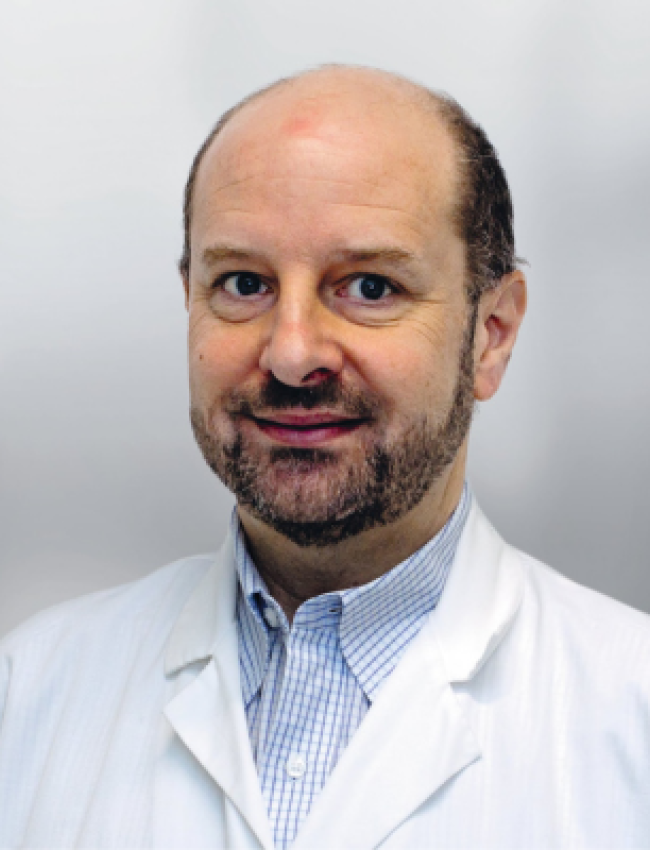
Keynote Lecture - "Functional genomics of the prion life cycle"
Type:
Lecture
Category:
Lecture
Place:
Geribá/João Fernandes Room
Date and time:
14:15 to 15:00 on 11/05/2025
The Aguzzi lab uses large-scale genetic perturbations to identify factors modifying discrete steps of the prion life cycle. Because most phenotypes relevant to prion biology require complex biochemical assays and are not selectable with surface markers, we resort to arrayed genetic screens in which the activation or ablation of each gene is tested individually. To achieve this, we invented massively parallel plasmid-cloning methodologies to construct arrayed libraries for the genome-wide ablation, activation and epigenetic silencing of human genes (42’378 discrete lentiviral vectors). In an arrayed genome-wide CRISPR activation screen, we identified 80 and 451 up- and downregulators of PrPC expression, respectively. 45 of the 50 strongest modifiers were confirmed in secondary assays. Many of these genes regulated PRNP transcription despite not being canonical transcription factors, and some affected PRNP transcription antithetically to PrPC protein expression, suggesting posttranscriptional regulation. Other PrPC modifiers impinged on lysosomal degradation, cholesterol metabolism, and mitochondrial function. Surprisingly, the strongest PrPC upregulators affected extracellular matrix (ECM) organization. PrPC levels correlated with ECM abundance, potentially mediated through mechanosensation of gliotic tissue stiffening in prion diseases. Prion entry into cells is a fundamental step of the prion life cycle, and its modulation may impact the establishment and spread of prion infections. A genome-wide CRISPR activation screen for modifiers of prion internalization yielded both expected modulators and novel candidates. Surprisingly, the Bone Morphogenetic Protein (BMP) pathway stood out as the most enriched pathway. Most members of the BMP signal-transduction chain (ligands, receptors, transcription factors) lit up in our screens, with activators and inhibitors leading to increased and decreased prion uptake, respectively. With a synthetic-lethality screen we discovered that ciliogenesis is a crucial contributor to Prion toxicity. We also identified Heterogenous Nuclear Ribonucleoprotein K (hnRNPK) as a factor limiting prion replication. Little is known about its function other that it is essential to cell survival. Using a synthetic-viability CRISPR ablation screen, we found that deletion and overexpression of Transcription Factor AP-2γ (TFAP2C) mitigated and enhanced the death of hnRNPK-ablated cells, respectively. hnRNPK ablation suppressed genes related to lipid and glucose metabolism and enhanced catabolism by modulating mTOR and AMPK, whereas TFAP2C overexpression promoted anabolism. TFAP2C overexpression reduced prion propagation in wild-type cells and neutralized prion accumulation in hnRNPK -suppressed cells. Hence, TFAP2C and hnRNPK are genetic interactors controlling cell metabolism, bioenergy and prion propagation. We are now expanding our approach to more prion-related phenomena, including synuclein phosphorylation after exposure to synthetic preformed synuclein fibrils. Our results showcase the awesome power of unbiased genetic perturbations for the study of neurodegenerative diseases and may enable the identification of novel therapeutically actionable targets.
![[object Object]](https://static.galoa.com.br/file/Eventmanager-Private/styles/attendee_dashboard_logo/s3/eventmanager_event/logo/Logo_40.png?VersionId=4_z9e083e414507696175f50716_f1094e69900372aef_d20240923_m210647_c003_v0312015_t0025_u01727125607404&itok=AIWDI7uW "[object Object]")